BBQ Guide
How To Slice A Brisket
The most important rule when slicing brisket is to cut against the grain. Proper slicing makes brisket easier to chew, improves presentation, and helps preserve moisture in each slice.
Quick Answer
Separate the point from the flat if desired, identify the grain direction, and slice across the grain rather than with it. Aim for slices about 1/8–1/4 inch thick (roughly 3–6 mm).
How To Slice A Brisket Step by Step
-
Rest the brisket first
Allow the brisket to finish resting before slicing so juices redistribute. Keep it wrapped during the rest. For short rests the counter is fine; for longer holds use a cooler, insulated tote, or a warm holding method. If you must hold cooked brisket hot for serving, keep the internal temperature at or above 140°F (60°C). Do not leave cooked brisket unwrapped at room temperature for more than 2 hours (or 1 hour if ambient temperature is over 90°F / 32°C).
-
Locate and separate the flat and point
A whole packer brisket contains two muscles: the leaner flat and the fattier point. The simplest way to separate them is to find the fat seam running between the muscles, place the tip of a sharp knife at one end of that seam, and follow it with long, shallow strokes until the muscles separate. If the seam is faint, look for a change in thickness or gently peel the point with tongs to expose the seam as you cut.
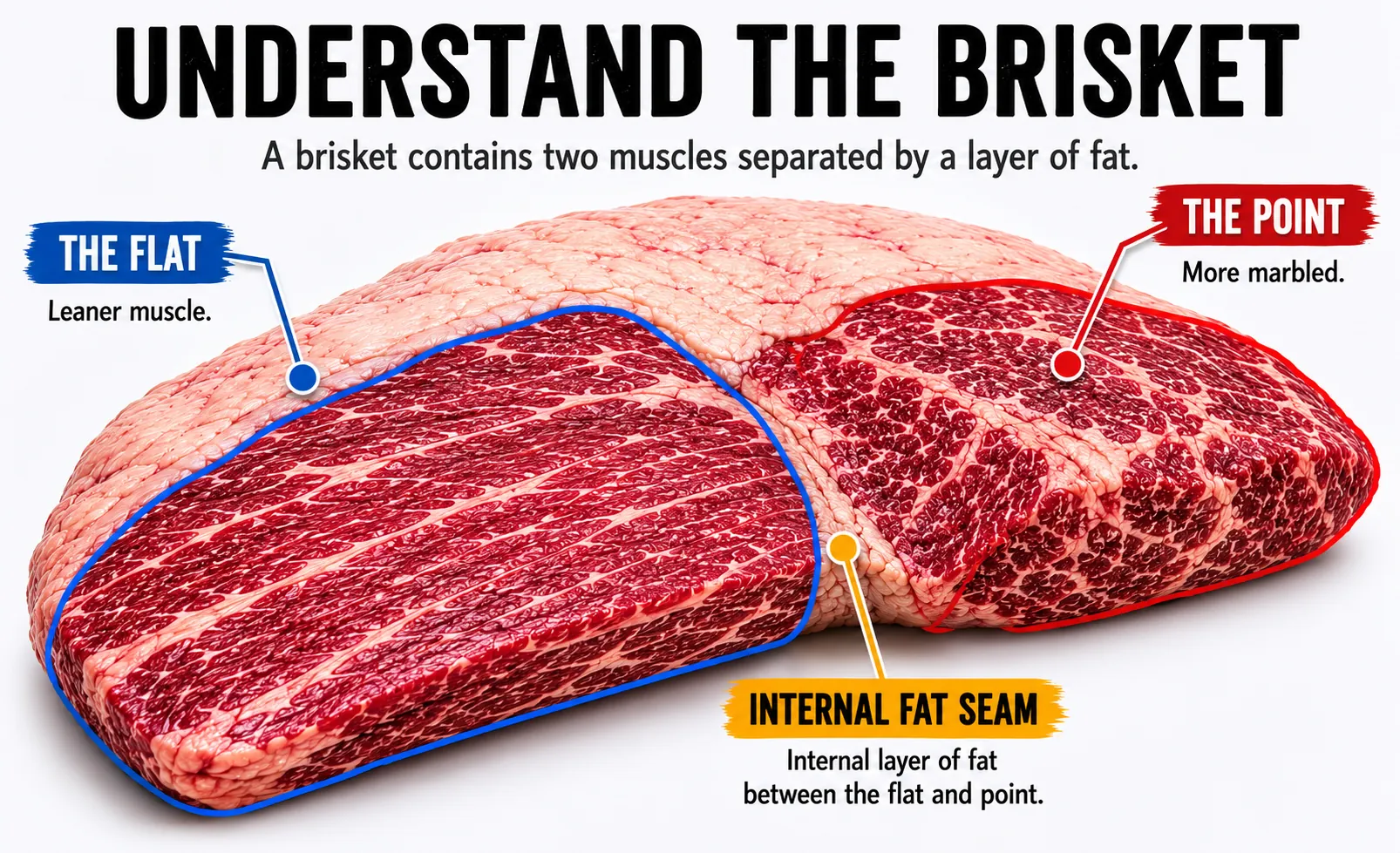
The flat is leaner and thinner. The point is thicker and more marbled. Briskets vary in shape and trimming, so use this as a simplified guide. -
Identify the grain direction
Look closely at the meat fibers. The grain is the direction the muscle fibers run. On many flats the fibers run lengthwise; on the point the fibers commonly change direction. If you’re unsure, examine the surface from different angles under good light to spot the fiber lines.
Note
If possible, identify the grain direction before seasoning and smoking. Once bark develops, the muscle fibers can be difficult to see.
-
Slice the flat against the grain
Cut perpendicular to the grain. This shortens the muscle fibers and improves tenderness.
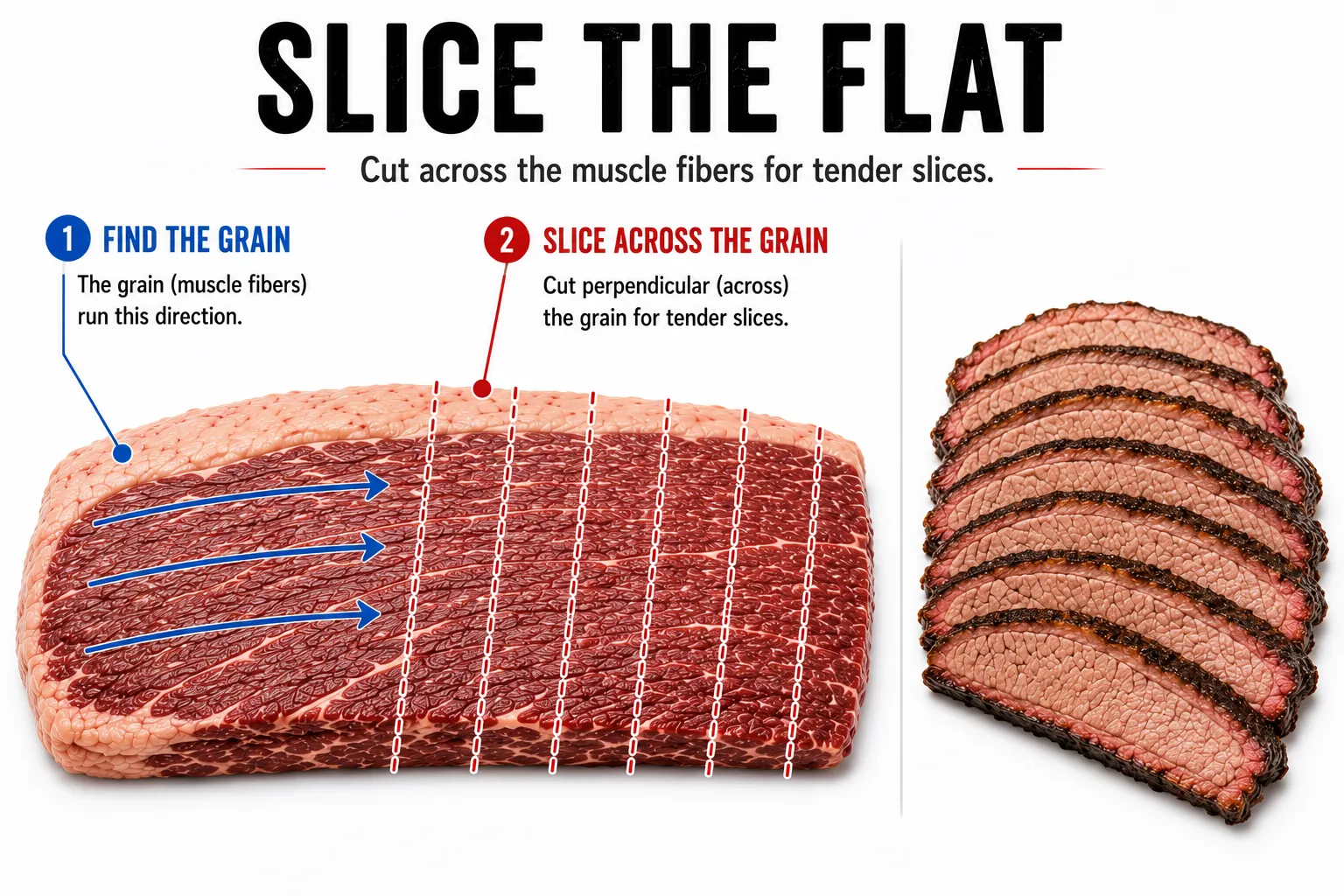
For the flat, find the direction the fibers run and slice across them into roughly 1/8–1/4 inch (3–6 mm) slices. -
Rotate for the point
The grain in the point typically runs differently than the grain in the flat. Adjust your slicing direction accordingly. Separating the point and flat first makes the change in grain direction easier to see and manage. For the point, slightly thicker slices or cubing for burnt ends are common options.
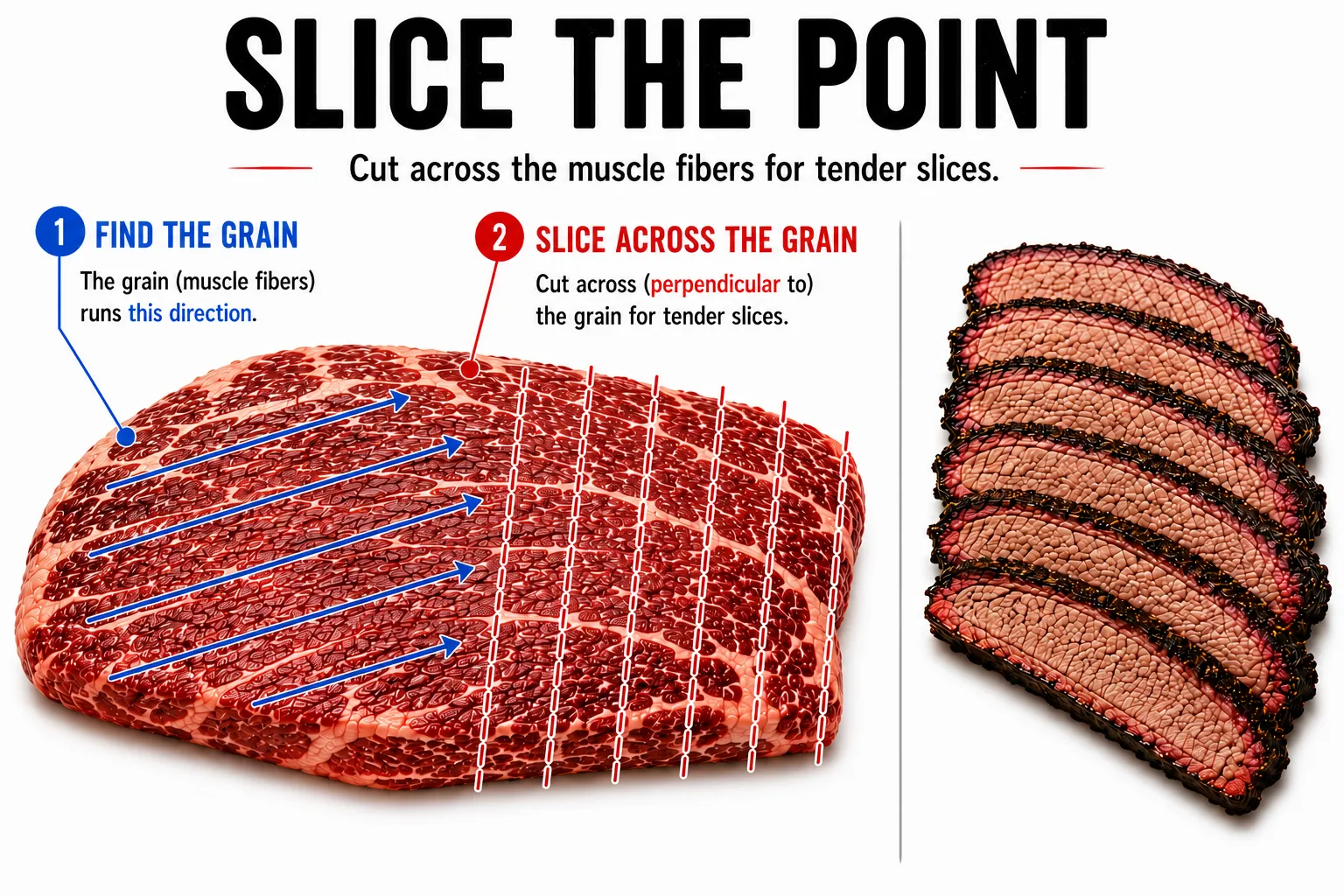
The point usually runs a different direction than the flat. Rotate it as needed so your slices cut across the fibers. -
Adjust thickness as needed
Aim for about 1/8–1/4 inch (3–6 mm) for most flat slices. The point can be sliced slightly thicker if preferred.
Common Mistakes
Slicing With The Grain
Even a perfectly cooked brisket can seem tough if it is sliced in the wrong direction.
Skipping the Rest
Slicing too early can cause excess moisture loss.
Treating the Point and Flat the Same
The grain direction changes, so the slicing direction often needs to change too.
FAQ
How thick should brisket slices be?
A common guideline is about 1/8–1/4 inch thick (roughly 3–6 mm).
Why is my brisket tough even though it was cooked properly?
The brisket may have been sliced with the grain rather than against it.
Do I separate the point and flat before slicing?
Many cooks do, especially when serving the point separately or making burnt ends.